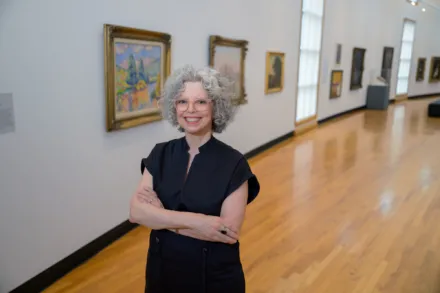
Photo by Della Perrone
Q&A with Krannert Art Museum’s New Director
Stephanie Smith brings a wealth of experience and a fresh perspective to her role as the new director of Krannert Art Museum. As she begins this new chapter at Illinois, she’s eager to build on the museum’s strengths, expand opportunities for students, and introduce new audiences to all Krannert Art Museum has to offer. We caught up with Stephanie to learn what drew her to Illinois, her vision for the museum’s future, and a few things you might not know about her.
You have held leadership roles at several outstanding museums. What was it about Krannert Art Museum, the university, and this community that made you say, “This is where I want to be?”
From our first conversations it felt like a great fit. I’ve loved working at other kinds of museums, from nimble contemporary spaces to massive museums with encyclopedic collections. Still, I’m always drawn back to the special energy of university art museums. Krannert Art Museum is a great one, with a long history of ambitious projects and a commitment to connecting art, campus, and community.
It’s also an exciting time to join the University of Illinois. Within a challenging landscape for higher education, the university seems to be doubling down on its commitments to public service and civic engagement, alongside research and teaching. The arts are key to all of those commitments. That’s a dynamic context for this museum as we collaboratively shape its next chapter.
More personally, this is biggest university I’ve ever worked at, and the smallest community I’ve ever lived in—and it’s great to be here! My husband Mark and I have been warmly welcomed on and off campus. And as a Midwesterner who grew up in St. Louis and retains strong ties to Chicago, it’s fascinating to be in a new part of Illinois. I’m learning a lot already about our region’s cultures, ecologies, and complex histories. (Not just through reading and culture: we’ve already been hiking and camping, and look forward to future kayaking.)
You have spoken about university museums bringing together art, ideas, and people. What does that look like in practice at Krannert Art Museum?
It takes different forms every day. A professor leading a conversation about works in the collection. Young people sketching during a teen retreat. A “creative aging” tour. A group of friends drifting through the galleries and chatting about an exhibition. Events that open new ways to encounter art, from a performance in the galleries to a critical conversation. Or an exhibition like Ink Shower, which the museum developed in partnership with InART Space in Taiwan and the Center for East Asian & Pacific Studies here at the university. It introduces stunning new art and creates opportunities for international artists to connect with their interdisciplinary colleagues, scholars, students, and the public right here. Across it all, we’re thinking about hospitality and how we welcome people into the museum.
Krannert Art Museum has long been a place where art intersects with teaching and research. What opportunities do you see for expanding collaborations across campus?
So. Many. Opportunities! We will work to enrich existing strong collaborations within the College of Fine and Applied Arts while also reaching across campus, and beyond. I’m looking forward to learning more about other collections and research centers on campus that could intersect with our work at the museum in powerful ways, such as the Prairie Research Institute.
How can the museum help students engage with art, regardless of their major or background?
I keep hearing from alumni about how Krannert Art Museum changed their lives for the better: through an internship, a job, participation in a research project, support from a mentor, or a place to recharge by connecting with culture. Sometimes the first step is simply to walking through our doors for a class. I’d like to strengthen and expand our capacity to connect with even more Illinois undergraduates across the whole campus. If they cross the threshold once for a class, maybe they’ll come back and find a home here in other ways.
As you begin your tenure, what are your priorities for the museum over the next few years? Whether it’s exhibitions, community engagement, student experiences, the collection, or philanthropy, what would you most like to accomplish?
Lots of ideas are marinating. I’ve only been the museum’s director for a few months. I’m still gathering many perspectives about past strengths, current context, and future potential. So, it’s still early, but over time we’ll strengthen student engagement, refresh our spaces, and hone our approaches to exhibitions and collections. I’m also thinking about how we might shape partnerships around long-term, interdisciplinary research initiatives. All of that takes resources so we’re also working to build a strong foundation of philanthropic support.
As we go, we’ll keep returning to the central question of what Krannert Art Museum’s distinctive role should be in this moment, and in its next chapter. What are the highest contributions we can make to the university, the region, the wider field? Many people hold a piece of the answer and it’s going to be fun to dig into this question, together.
Rapid-Fire Round
Complete the sentence…
- The first experience that made me fall in love with museums was … undergraduate class visits to the Menil Collection with a great art history professor.
- Opening night or later … openings for community, later for art.
- My favorite places to think are … with other people and a whiteboard, with other people over a meal, or alone in the garden.
- The best advice I ever received was … show up, and say thank you.
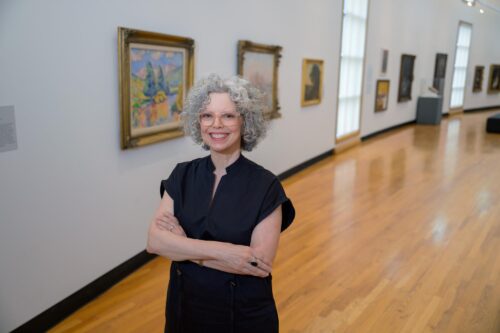
Photo by Della Perrone