Drew Friedman Believes in the Alchemy of Theatre
By Mariana Seda
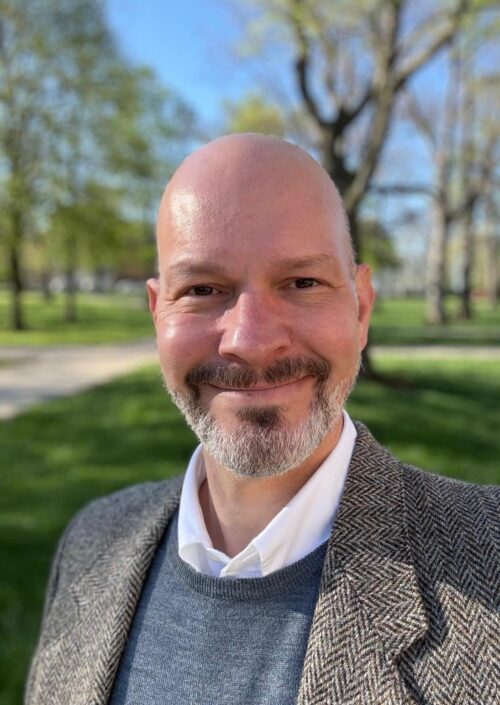
The Department of Theatre opened the year with a new addition to the company: incoming Department Head Drew Friedman. Friedman brings a rich and varied career to the role—years as a performing artist devising and touring original work, the founder of a theatre group, and a collaborator with award-winning theatre companies—alongside an impressive repertoire of scholarship, teaching, and leadership. With the start of a new season on the horizon, we wanted to learn more about the person leading the way … so we asked him a few questions.
Your career has oscillated between creative practice, scholarship, teaching, and leadership. How have these roles informed, or perhaps even transformed, how you approach one another over the years? Have there been moments when they’ve been in tension or when one fundamentally changed the way you thought about another?
I’m so grateful I’ve had the opportunity to work in these various capacities, and each has highlighted my strengths and challenged me to grow in new ways. What draws me to these different roles is that each has given me opportunities to think creatively, solve problems, and, most importantly, collaborate. They taught me that what I value most in all the work I do is collaboration—what I would call the love of doing or making things with others for others.
Your research explores theatrical experimentation and provocation. What do you think theatre can do that no other art form can?
Theatre has a unique relationship to the past and present. We take elements from the past—whether they be stories or situations—and try to make them feel alive in the present. Even when we create new works, they are most often rehearsed, if not fully scripted. When we present these works to an audience, the question I’m consumed by is: Does it feel alive and meaningful right here and right now? Theatre tries to achieve that sense through a combination of technique, skill, and craft, but the audience and the present moment also have a say in theatre’s success. It’s a strange collaboration, an unpredictable alchemy, but when it works, it’s magic!
What made this department feel like the place where you wanted to spend the next chapter of your career?
The people! From day one, I recognized that the members of this department and the students who come here to learn share a commitment to kindness, excellence, and innovation. They believe we can achieve big, exciting things, and we can do them together. For me, that’s a recipe for feeling inspired, challenged, and supported.
What possibilities excite you most about this moment for Illinois Theatre?
Illinois Theatre is poised to lead the conversation of what theatre is and means in the 21st century, because we are actively reimagining what our art form can be. This year we launched a newly revised, dynamic curriculum for our BFA and MFA Acting students; Theatre Studies is launching a new BA degree in Immersive and Interactive Theatre; we are thrilled to announce that Level 21 now offers the Dr. Jan Marie Aramini & Michael S. Pettersen Design and Technology scholarship and the Mahin Rassi Excellence in Costuming Award; our faculty, staff, and students are practicing the technical skills and conventions of their craft using cutting-edge technology in state-of-the-art facilities; we have boundary-pushing artists in residency; we are commissioning new works for the stage and reimagining how audiences and artists gather. Illinois Theatre is stepping bravely into the future of our art form. That is exciting!
When students leave Illinois four years from now, what do you hope they carry with them besides technical skills?
A brave and bold mindset, which I would define as the courage to dream big and the commitment to pursue one’s dreams and ambitions. If you combine that mindset with the world-class training our students receive, I believe you are set up to succeed in any profession and wherever your life may take you.
What do you wish more people understood about experimental theatre?
Experimentation is one of the great traditions of all the arts. Nearly every element of theatre that is seen as conventional today was once an experiment: curtains, memorized lines, realistic sets, dimming the lights—at one point, all of these were innovative, if not radical, ideas. Experimentation and convention are interdependent.
What’s a habit you’ve seen in the most successful young theatre artists?
Building friendships with people who understand your goals and share your interests. Everyone knows a career in theatre can be challenging, and having people who can appreciate your struggles, celebrate your accomplishments, and remind you who you are and what you want to achieve is invaluable. I have felt a lot of doubt and uncertainty throughout my career, and the people I started making theatre with as an undergraduate 30 years ago have supported me every step of the way!
Rapid-Fire Round
Complete the sentence …
- The first play that made me fall in love with theatre was … Macbeth: the witches!!!!
- A rehearsal room should always have … water.
- My favorite place to think is … on a walk.
- The best advice I ever received was … If you want to learn your lines, you need to practice your lines.
- Opening night or closing night? … Wednesday matinee with a half-full audience and bad weather!