
Community engagement in Danville, Illinois. Photo by Nick Talan.
The Job Is the Lesson
By Mariana Seda
It is a truth universally acknowledged that a student in possession of a fresh, new degree must be in want of a job—and, more urgently, the skills to keep it. For Urban and Regional Planning students, a series of required senior and graduate workshops make sure that want doesn’t go unmet, pairing them with communities and real planning problems long before graduation.
Each semester, the workshops tackle different issues in different places, but the expectations stay the same: students engage directly and intimately with a community, produce a professional-quality deliverable, and sharpen both their technical and public engagement skills along the way. These are not thought experiments, either. The workshops are deliberately taught by adjunct faculty—sometimes program alumni themselves—who are working planners and can bring the field’s friction into the classroom. Students partner with actual communities to develop plans and proposals built around that community’s needs.
Eric Van Buskirk, AICP, senior planner for the City of Champaign, runs his junior and senior workshops like a planning office. Junior-year students kick off the semester with fundamentals like drawing, scaling, and learning how to do a Kevin Lynch analysis—an observation method that helps planners understand how people perceive and navigate a particular place. They spend the rest of the semester drafting a mock comprehensive plan for an actual city, with wide latitude to imagine what that city could become. “I really stress: think big and be creative,” said Van Buskirk. “You have an entire career to look forward to where you have constraints and public expectations, so it’s really a chance to show me your ideal thing or what you’re most passionate about.”
The rigor pays off well beyond the classroom. Students learn software like ArcGIS and Adobe Creative Suite so they can communicate their ideas visually and more effectively to planning professionals. “You have to show me,” said Van Buskirk. “Show me the building, show me the plaza, show me the street. Don’t just write about it. No one’s going to read it.” After presenting their work to planners in the community they are studying, students gain valuable outside feedback that coursework alone can’t supply. The workshops have a reputation for being demanding, according to Van Buskirk, but he hears the same thing from alumni repeatedly: “I thought your class was hard. And then I went to work and I realized your class was literally just the job.”
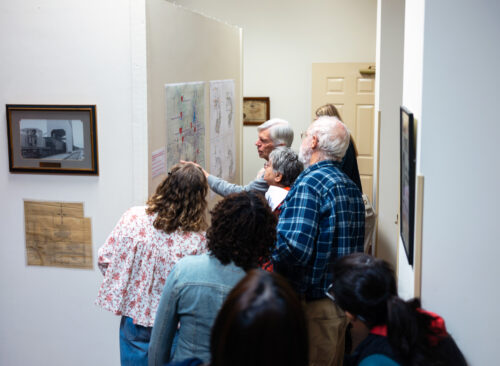
Community engagement in Danville, Illinois. Photo by Nick Talan.

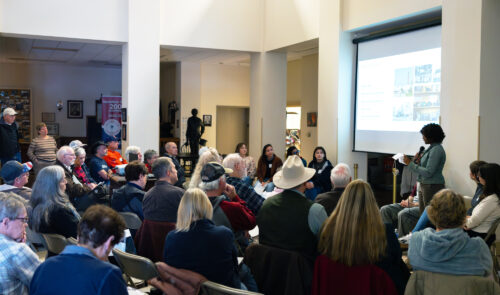
Presentation in Danville, Illinois. Photo by Nick Talan.
The Job Is the Lesson Cont.
Emily Guske, a research specialist at the Climate Jobs Institute (CJI) and an Urban Planning alumna herself, built her workshop on the same principle. Organized under CJI’s Illinois Coal Workers & Communities Listening Project, the workshop tasked graduate students with exploring how the state’s coal industry shapes local communities. Rather than have students research coal country from behind a laptop, she sent them to it—specifically, to Vermilion County, 30 minutes and a world away from campus. “One main goal of the workshop was to get them hands-on experience with placemaking and doing community-engaged fieldwork,” said Guske. Students toured the Vermilion County Museum and the Westville Museum with local residents, walked the reclaimed forest at Kickapoo State Park—once coal mine land—and sat with community members to record their stories.
The community engagement served as a glimpse into the profession these students hope to step into. “I think it can be powerful, especially for young planners who are going to have to do this no matter what field they enter. They’re going to have to communicate with their local community and understand what is important to them,” explained Guske. The students turned their research into an interactive StoryMap, then took it back to the people, presenting to roughly 40 community members at the Vermilion County Museum and absorbing the feedback that followed. It’s the kind of exchange Guske says is easy to skip but essential to experience. “The students may have their own positions or their own perspectives, but having that two-way engagement is important to practice,” she said.
Guske’s students leave having already sat across the table from the people their decisions will affect—processing feedback, revising in the moment, and learning to listen as closely as they design. This real-world, high-value experience is a core aspect of earning a degree in Urban Planning at Illinois, and employers take notice. The want, as it happens, was never really about luck.
Presentation in Danville, Illinois. Photo by Nick Talan.