Rooted and Rising: Sustainable Design Hits Its Stride
By Mariana Seda
From developing sustainable materials that fight deforestation to turning food waste into fresh homegrown food, Sustainable Design alumni are defining their own paths in the professional world. Graduates are procuring work at architecture and design firms, at startups, and within other emerging sustainability careers, serving as consultants or filling brand new roles companies have never had before. Their success reflects a young program with plenty of momentum that is quickly coming into its own.
Karin Hodgin Jones, director of the Sustainable Design program (BSSD), says this is partly due to an interdisciplinary curriculum that imbues students with the curiosity and confidence to explore uncharted pathways.
“There aren’t many comparable programs in the states,” said Hodgin Jones, “but what is unique about our curriculum is our high degree of engagement with multiple fields of design and their practices. Our students graduate as well-resourced design generalists who understand the internal vernacular of each of these design fields and can work very effectively on project teams, bringing specialists from all these areas together. They could also have a deep focus in other areas like business, engineering, or environmental sustainability. They can really chart a path that is unlike anyone else in their cohort.”

Patrick Fitzgerald with his family at graduation
BSSD Cont.
And they are.
As a student, Patrick Fitzgerald (BS ’23 Sustainable Design) dismantled a solar panel to examine which materials could be recycled, recovered, or redesigned to reduce waste at the end of a panel’s life. He found that 95% of a solar panel’s materials are recoverable—though today, the US actually recycles only about 10% of decommissioned panels, since disposal is cheaper. The project earned him an internship in Boston, where he shared his research with others while deepening his expertise in solar energy materials. Today, Fitzgerald is a solar design engineer at Revamp Engineering, Inc. in Chicago, where he designs and engineers utility-scale solar projects ranging from 500 to 5,000 MW–including a current project of roughly 5.6 GWdc.

Patrick Fitzgerald with his family at graduation

Asher Lin promotes AutoSitu
BSSD Cont.
Xuanshu “Asher” Lin (BS ’23 Sustainable Design, BA ’23 Urban Studies) took a different route. After completing a master’s degree in Urban and Regional Planning, Lin cofounded AutoSitu, an AI platform that helps architects, planners, and developers identify problems in building and site plans before projects move forward. Lin says his education taught him to bridge design, planning, technology, and human needs—an interdisciplinary mindset that now guides his work developing tools that support, rather than replace, professional judgment. That approach recently helped AutoSitu earn a $500,000 grant from Y Combinator to accelerate the company’s growth. AutoSitu is also backed by Robinhood, Detroit Venture Partners, Pi Labs, and other industry leaders.
As graduates spread into emerging roles, they have also begun shaping the next chapter of the program itself. With a relatively young program like BSSD, maintaining relationships with alumni is an essential part of improving it and student outcomes. Because graduates are spread across different industries, they don’t naturally encounter one another at a recurring conference or through a professional association directory.

Asher Lin promotes AutoSitu
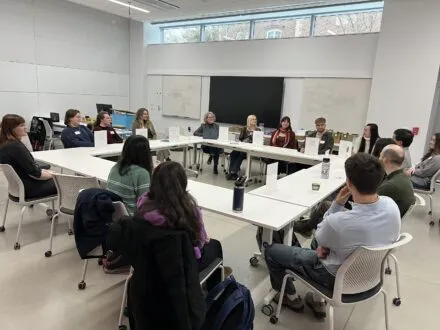
BSSD alumni panel
BSSD Cont.
In a recent panel hosted by BSSD, several alumni returned to campus to meet in person and speak with students about their career journeys. As pioneers in a growing field, these alumni have built a professional community among themselves and are cultivating relationships across their fields and with the up-and-coming students still in the program. Motivated by their own experiences navigating new and evolving career paths, the visiting alumni decided to establish a mentoring network and advising program to help smooth the path to professionalism for graduates.
“The most exciting thing about getting them in contact with one another is this reinforcement of a community that is genuinely taking exciting risks on doing something that’s new,” said Hodgin Jones.
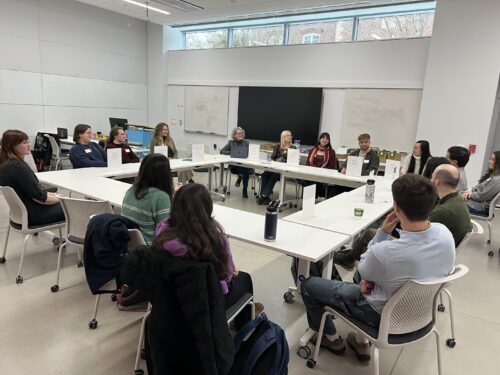
BSSD alumni panel
Most of [the alumni’s] positions are new in the past 10 years, and many are new because our graduates are creating them.
BSSD Cont.
Six years after launching, the Sustainable Design degree program has taken root, supporting over 90 current students—a number much higher than was ever expected. When the new program started accepting students in 2020, most were transferring from other art or design areas within the college, wanting to deepen their understanding of sustainability within their chosen fields and discovering Sustainable Design as an option. But recent cohorts indicate a major shift in the origins of admitted students.
“In the past couple of years, we are seeing students who are studying environmental sciences, human geography, and AP courses that are focusing on sustainability in high school, and they are beginning to recognize that there are paths that continue those studies within design,” explained Hodgin Jones. “Students are coming into the program already understanding what it is and what might be in the curriculum.”
As the student population grew rapidly, so did the administrative and instruction needs for the program. The college invested in program coordination support, and this year BSSD is partnering with other units to hire full-time professors to teach sustainable design within Architecture, Urban Planning, Art and Design, and Landscape Architecture. It’s part of an effort to build an interdisciplinary curriculum with embedded sustainability experts from different fields of design. It’s also yet another indicator of the program’s momentum.
“I think we’re at a real turning point for sustainability,” shared Hodgin Jones. “We don’t have to broadcast sustainability and ask people to buy into the concept. I think the students who come out in the next year or two are going to find their way into opportunities to execute sustainable design, not as a second or extra step in the design process, but as an integrated part of the natural ways businesses, communities, and organizations work.”